Many South African employees feel financially protected because their employer offers disability insurance as part of their employee benefits. It is a valuable benefit, and in many cases it can provide important support if illness or injury prevents you from working. But the real question is not whether you have disability cover through your employer — the real question is whether that cover is enough for your personal financial responsibilities. Your employer’s disability insurance may help, but it may not fully protect your income, your debt obligations, your family, and your long-term financial plan.
Employer Disability Cover Is a Good Start
Employer disability insurance is usually offered as part of a group risk benefit. This means the employer, retirement fund, or employee benefits structure arranges cover for a group of employees under one policy. In many workplaces, this may include income disability cover, lump-sum disability cover, or both.
The advantage is that group cover is often easier to access than individual cover. You may not need the same level of personal underwriting, and the premium may be subsidised or deducted automatically. This makes it a powerful safety net, especially for employees who might otherwise delay taking out cover on their own.
However, group cover is designed for a broad group of employees — not specifically for your personal lifestyle, debt, dependants, financial goals, and household obligations. That is where the possible gap begins.
[READ MORE]: How to Protect Your Family Financially After Death?
The Cover Amount May Not Match Your Real Needs
Your employer’s disability benefit may only cover a percentage of your salary. For example, an income disability benefit may replace part of your monthly income, but not necessarily your full take-home pay. If your household already depends on every rand of your salary, even a partial reduction can create pressure.
You also need to consider what expenses will continue if you become disabled. Your bond or rent will still be due. Groceries, school fees, medical aid, transport, debt repayments, insurance premiums, family support, and daily living expenses will not disappear. In fact, some costs may increase because disability can bring medical shortfalls, rehabilitation costs, mobility needs, assistive devices, or home adjustments.
This is why you should not only ask, “Do I have disability cover?” You should ask, “How much income would my family actually receive, and would it be enough?”
The Definition of Disability Matters
One of the most important parts of any disability policy is the definition of disability. Some policies assess whether you can perform your own occupation, while others assess whether you can perform any reasonable occupation based on your education, training, and experience.
This matters because you may be unable to do your current job, but the insurer may still consider whether you can do another type of work. For example, a financial adviser, call centre manager, administrator, teacher, technician, or sales consultant may all depend on different skills, mobility, mental focus, communication, and emotional resilience. If a condition affects your ability to do your specific job, your claim outcome will depend heavily on the wording of the policy.
Employer group policies may have standard definitions that apply to everyone. Personal disability cover can sometimes be structured more carefully around your occupation and income needs.
Your Cover May Be Linked to Your Employment
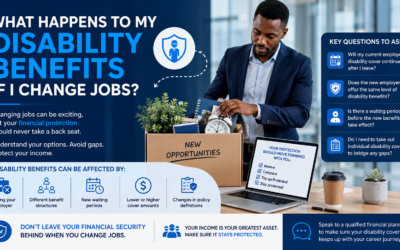
Another major issue is that employer disability cover is usually linked to your job. If you resign, are retrenched, move companies, become self-employed, or your employer changes benefit providers, your cover may change or fall away.
This creates a risk because your need for disability protection does not end when you leave an employer. In fact, changing jobs can sometimes leave you temporarily exposed. If your health changes after leaving your employer, getting new personal cover may become more difficult, more expensive, or subject to exclusions.
Personal disability insurance gives you more control because it belongs to you, not your employer. It can continue even when your career path changes, provided premiums are paid and policy terms are met.
Tax and Benefit Structure Should Be Understood
Employer disability benefits may be structured differently depending on the policy and benefit arrangement. Some benefits may pay monthly income, while others may pay a lump sum. Some may be linked to retirement fund rules, while others may be separate group risk benefits.
The key point is that you must understand how your benefit will actually work at claim stage. Will the payout be monthly or once-off? Will it continue until recovery, retirement, or a specified period? Will it increase with inflation? Will it reduce if you receive another income? Will it be enough after tax and deductions?
Many employees only discover the answers after a claim event. A better approach is to review the benefit while you are healthy and employed, so you can identify shortfalls early.
Employer Cover May Not Address Capital Needs
Disability does not only create an income problem — it can also create capital needs. You may need a lump sum to settle debt, modify your home, buy assistive equipment, fund rehabilitation, adapt your vehicle, or create an emergency reserve.
If your employer only provides income disability cover, it may help with monthly expenses but not large once-off costs. If your employer only provides a lump-sum benefit, it may help with capital needs but may not replace your salary sustainably over many years.
A strong disability plan should look at both sides: monthly income needs and capital needs. One benefit alone may not be enough.
Your Family Situation Makes a Big Difference
Two employees earning the same salary may need very different levels of disability cover. One may be single with low debt and strong savings. Another may have children, a bond, ageing parents, school fees, and a spouse who depends on their income.
That is why relying only on employer cover can be risky. Group benefits do not always reflect your personal responsibilities. A proper financial needs analysis will consider your dependants, debts, lifestyle, emergency savings, medical aid, retirement plans, and long-term goals.
Your disability cover should be built around your life — not only your payslip.
Should You Add Personal Disability Cover?
In many cases, personal disability cover can complement employer benefits. It can help close the gap between what your employer provides and what your household actually needs. It can also give you continuity if you change jobs, and flexibility if you need cover that is better aligned to your occupation or financial plan.
This does not mean every employee needs the same amount of additional cover. Some may need income protection. Some may need lump-sum disability cover. Some may need both. Others may only need a small top-up because their employer benefits are strong.
The right answer depends on your full financial picture.
Final Thoughts
Your employer’s disability insurance is valuable, but it should not be accepted blindly as “enough.” It may be a good foundation, but your personal financial responsibilities may require more protection. The danger is not having employer cover — the danger is assuming it will fully replace your income, protect your family, settle your debts, and fund your recovery without checking the details.
Before you rely on your employer’s disability benefit, ask these questions: How much will it pay? When will it pay? How long will it pay? What definition of disability applies? What happens if I leave my employer? Will it cover my income needs and my capital needs?
Disability insurance is not just an employee benefit. It is a financial survival plan. Review your employer cover with a qualified financial planner and make sure your protection matches the life you are working so hard to build.