Changing jobs can be exciting. It may mean better income, career growth, improved working conditions, or a new opportunity to build the life you want. But before you sign the new offer and celebrate the move, there is one important question many South Africans forget to ask: what happens to my disability benefits if I change jobs? If your disability cover is linked to your employer, changing jobs can affect your protection — and in some cases, it may leave you exposed if you do not plan properly.
Employer Disability Benefits Are Usually Linked to Your Employment
Many South African employees receive disability benefits through their employer as part of a group risk or employee benefits package. This cover may include income disability benefits, lump-sum disability cover, waiver of premium benefits, or other related risk benefits.
The important point is that employer-provided disability cover usually belongs to the employer’s group scheme or retirement fund structure — not directly to you as an individual policyholder. This means that when your employment ends, your participation in that scheme may also end, unless the policy rules provide a continuation or conversion option.
In simple terms, your cover may not automatically follow you when you move to a new company.
Your Cover Could Stop When You Leave
If you resign, are retrenched, or move to another employer, your group disability benefit may stop on your last day of employment or at the end of the relevant benefit period stated in the scheme rules. This can create a dangerous gap between your old job and your new job, especially if your new employer does not provide the same level of disability cover.
For example, your previous employer may have offered income protection and lump-sum disability cover, while your new employer may only offer a basic group life benefit. Or your new employer may have a waiting period before benefits become active. During that period, you may have less protection than you assumed.
This is why it is important to review employee benefits before changing jobs — not only the salary.
Your New Employer’s Benefits May Be Different
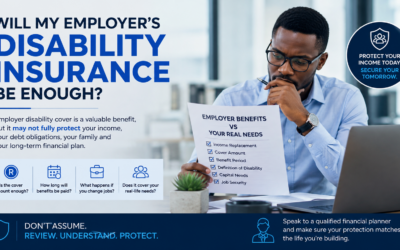
Not all employer disability benefits are the same. One employer may provide strong group risk benefits, while another may offer limited cover. The percentage of income covered, waiting period, benefit term, policy definitions, exclusions, premium structure, and claim requirements can differ significantly.
You should ask your new employer or HR department for a full employee benefits summary before making a final decision. Look specifically at:
- The disability benefit amount.
- Whether the benefit is monthly income, lump sum, or both.
- The waiting period before a claim can be paid.
- The definition of disability used by the insurer.
- Whether benefits continue to retirement age or only for a limited period.
- Whether the cover includes waiver of premium or retirement contribution protection.
- Whether cover starts immediately or after a probation period.
These details matter because a higher salary does not always mean a stronger financial position if your risk benefits are weaker.
You May Need to Reapply for Personal Cover
If you rely only on employer benefits, changing jobs may force you to depend on whatever the new employer provides. But if you have personal disability insurance, that cover usually remains with you even when you change jobs, provided you continue paying premiums and meet the policy terms.
This is one of the biggest advantages of personal cover: it gives you continuity. Your career may change, but your financial protection does not have to start from zero every time you move.
However, if you decide to take out personal disability cover only after changing jobs, you may need to go through underwriting. The insurer may assess your age, occupation, income, medical history, lifestyle, and financial need. If your health has changed since your previous employment, you may face higher premiums, exclusions, or even declined cover.
That is why it is better to review personal cover while you are healthy and still insurable.
Your Occupation Classification Can Affect Your Cover
When you change jobs, your occupation may change in a way that affects disability insurance. Insurers assess risk partly based on the type of work you do. An office-based manager, travelling sales consultant, technician, construction supervisor, driver, or self-employed business owner may all be viewed differently from a risk perspective.
If your new role involves more travel, manual work, hazardous environments, irregular income, or self-employment, your disability cover may need to be reviewed. Some policies require you to inform the insurer when your occupation changes. Failing to disclose a material occupational change could create problems at claim stage.
Before changing jobs, check whether your personal policy requires notification of occupational changes and whether your new role affects your premium or benefit terms.
What If You Change Jobs While Already Disabled?
Changing jobs while already ill, injured, or in the process of claiming disability benefits can be more complicated. Claims under employer group schemes are generally assessed according to the policy rules, employment status, and the date the disability event occurred. In employee benefits structures, disability claims can involve questions about ongoing employer responsibilities, retirement contributions, group risk premiums, and medical aid participation. Industry commentary in South Africa notes that disability claims can create uncertainty around the employer’s ongoing responsibility for benefits while the employee is unable to perform their duties.
If you are already experiencing health issues or are considering a disability claim, do not resign without getting advice. Resigning at the wrong time can affect your employment benefits, claim process, and financial position.
Speak to HR, your employee benefits consultant, your financial planner, and where necessary, a labour or legal professional before making a decision.
Check for Conversion or Continuation Options
Some group schemes may offer a conversion option, allowing you to take up individual cover after leaving employment without full medical underwriting, subject to specific conditions and timelines. This is not guaranteed and depends on the insurer and scheme rules.
If such an option exists, there is usually a limited window to apply after leaving employment. Missing the deadline may mean losing the opportunity. Before your last day at work, ask HR or the employee benefits provider whether your disability benefits include any continuation, conversion, or portability option.
Do not assume this exists — confirm it in writing.
Why a Benefits Gap Can Be Dangerous
A benefits gap is the period where you have little or no disability cover between jobs. Even a short gap can be risky because illness or injury does not wait for your new benefits to start.
If you are the main income earner, have debt, dependants, school fees, medical aid costs, or family responsibilities, a gap in disability cover can create serious financial vulnerability. Your income may stop, but your expenses will continue.
This is why changing jobs should trigger a full financial protection review. Your salary, benefits, retirement fund, medical aid, life cover, disability cover, and income protection should all be assessed together.
What Should You Do Before Changing Jobs?
Before you move to a new employer, take time to compare your old and new benefits. Do not only compare gross salary. Look at the full package, including risk benefits and retirement contributions.
Ask for the employee benefits booklet from your current employer and the new employer. Then speak to a qualified financial planner to identify any shortfall. You may need to top up your disability cover with personal income protection or lump-sum disability insurance.
The goal is not to duplicate cover unnecessarily. The goal is to make sure your protection continues smoothly and matches your real financial responsibilities.
Final Thoughts
So, what happens to your disability benefits if you change jobs? In many cases, employer disability benefits may stop when you leave, and your new benefits may be different, delayed, or weaker than expected. If you rely only on your employer’s cover, your protection can change every time your employment changes.
Personal disability insurance can help create continuity, especially when your career path changes. But the best time to review cover is before you resign, not after something goes wrong.
A new job can improve your income, but make sure it does not quietly reduce your financial protection. Before you accept the offer, review the benefits, understand the gaps, and protect your ability to earn.