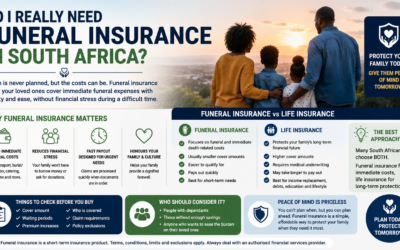
In South Africa, funeral insurance and life insurance are often spoken about as if they are the same thing. They are not. Both can pay money when someone passes away, but they solve very different financial problems. Funeral insurance is mainly designed to help your family pay for immediate funeral-related costs. Life insurance is designed to protect your loved ones financially after death by replacing income, settling debt, funding education and helping your family maintain their lifestyle.
This distinction matters because many South African families carry both emotional and financial responsibilities when a loved one dies. A funeral may need to be arranged within days, while the longer-term financial impact of death can last for years. ASISA reported that life insurers settled 94.1% of death claims in 2025 under individual life, credit life, funeral and universal life policies, paying beneficiaries R44.2 billion in benefits. This shows how important these products remain in household financial planning.
What Is Funeral Insurance?
Funeral insurance, also called funeral cover or a funeral policy, is designed to pay a benefit when an insured person passes away. The purpose is usually to help cover funeral expenses such as the coffin, service, transport, food, family travel, burial costs and related cultural or family obligations.
One of the biggest advantages of funeral cover is accessibility. It is often easier to apply for than traditional life insurance, may require limited or no medical underwriting, and is usually designed for faster claims processing once the required documents are submitted. This is why funeral cover is popular in South Africa, especially in households where families want immediate cash flow after death.
However, funeral cover is usually limited in size. It is not designed to replace years of income or provide long-term financial security. It may help with the funeral, but it may not be enough to cover a bond, school fees, debt, groceries or the surviving family’s monthly expenses.
What Is Life Insurance?
Life insurance, also called life cover, pays a lump sum when the insured person passes away, provided the claim meets the policy terms and conditions. Unlike funeral insurance, life insurance is usually designed for bigger financial responsibilities. It can help your family settle debt, pay off a home loan, replace your income, fund children’s education, support a spouse and maintain the household’s standard of living.
Life cover often requires underwriting, which means the insurer may assess your age, health, occupation, lifestyle, smoking status, medical history and financial need before approving the policy and premium. Because the insurer assesses risk more deeply, life insurance can often provide much higher cover amounts than funeral insurance.
The key purpose of life insurance is not only to pay for burial costs. It is to answer this question: If my income disappeared because I passed away, would my family still be financially secure?
The Key Difference
The simplest way to understand the difference is this: funeral insurance pays for the immediate cost of saying goodbye; life insurance protects the long-term financial future of the people left behind.
Funeral cover is short-term in purpose. It helps your family deal with urgent funeral expenses. Life cover is long-term in purpose. It helps your family survive financially after your income, care and financial contribution are gone.
For example, a R30 000 or R50 000 funeral policy may help pay for a dignified funeral. But if you have a spouse, children, a bond, vehicle finance, personal loans and school fees, that amount may be used up quickly. Life cover may be needed to deal with the larger financial gap.
Funeral Insurance vs Life Insurance: Side-by-Side
| Feature | Funeral Insurance | Life Insurance |
|---|---|---|
| Main purpose | Pays for funeral and immediate death-related costs | Protects dependants financially after death |
| Typical payout size | Usually smaller | Usually much larger |
| Application process | Often simpler, with limited underwriting | Usually more detailed underwriting |
| Claim timing | Often designed for faster payout | May take longer due to claim assessment |
| Best for | Burial costs, family funeral obligations, immediate cash needs | Income replacement, debt settlement, education funding, long-term family support |
| Premium structure | Usually affordable for smaller cover amounts | Depends on age, health, lifestyle and cover amount |
| Medical questions | Often fewer | Usually more detailed |
| Can it replace the other? | Not fully | Can include funeral needs, but may not pay as quickly |
When Funeral Insurance May Be the Better Starting Point
Funeral insurance may be a good starting point if your biggest immediate concern is making sure your family can arrange a dignified funeral without borrowing money. It can also be useful if you want to cover extended family members such as parents, grandparents, siblings or other dependants, depending on the insurer’s rules.
It may also suit people who cannot yet afford larger life insurance premiums or who want a simple benefit for immediate death-related expenses. In many South African families, funeral obligations are not only financial; they are cultural, emotional and social. Having funeral cover can reduce stress during a painful time.
But funeral cover should not be mistaken for full financial protection. It may solve the funeral problem, but it may not solve the family income problem.
When Life Insurance May Be the Better Choice
Life insurance becomes more important when people depend on your income. If you have children, a spouse, parents who rely on you, debt, a home loan or business responsibilities, life cover should be strongly considered.
A proper life insurance amount should take into account your outstanding debts, future living expenses, education costs, estate costs, emergency needs and the income your family would lose if you were no longer there. This is especially important in South Africa, where one salary often supports more than one household.
If you are the main breadwinner, funeral cover alone is unlikely to be enough. Your family may be able to bury you, but still struggle to live without you.
Can You Have Both?
Yes, and in many cases, having both makes sense. Funeral insurance can provide quick cash for immediate costs, while life insurance can provide a larger payout for long-term financial security. These products can work together instead of competing with each other.
Think of funeral cover as the money your family may need in the first few days or weeks. Think of life cover as the money they may need for the months and years after that. A balanced financial plan may include both, along with disability cover, critical illness cover, income protection, medical aid, gap cover, emergency savings and estate planning.
What Should You Check Before Choosing?
Before choosing funeral insurance or life insurance, read the policy terms carefully. For funeral cover, check the waiting periods, exclusions, covered family members, maximum cover limits, premium increases and claim requirements. ASISA has previously noted that funeral insurance commonly has no underwriting requirements, which is one reason waiting periods and claim rules are important.
For life insurance, check the underwriting requirements, exclusions, premium pattern, cover term, beneficiary nominations, claim process and whether the benefit is enough for your family’s actual needs. Also check whether your cover is standalone or linked to another product, and whether it will still be affordable as you get older.
Premium Payable: Cheapest Is Not Always Best
Funeral cover may appear cheaper because the benefit amount is usually smaller. Life insurance may seem more expensive, but it may provide significantly more protection per rand of premium, especially for younger and healthier clients who qualify for favourable underwriting.
The right question is not only, “How much is the premium?” The better question is, “What financial problem does this policy solve, and is the payout enough?” A cheap policy that does not meet your family’s needs can still leave them financially exposed.
Which Should You Choose?
Choose funeral insurance if your priority is to make sure your family has quick money for funeral costs and immediate arrangements. Choose life insurance if your priority is to protect your dependants from long-term financial hardship after your death.
For many South Africans, the best answer is not funeral insurance or life insurance. The best answer is funeral insurance for immediate costs and life insurance for long-term protection. If your budget only allows one, start by asking what risk would hurt your family the most: the cost of the funeral, or the loss of your income and financial support.
Final Thoughts
Funeral insurance and life insurance both have value, but they are not interchangeable. Funeral cover helps your family bury you with dignity. Life cover helps your family continue living with financial stability after you are gone.
If you have no dependants and only want to cover burial expenses, funeral insurance may be enough for now. But if anyone depends on your income, life insurance should be part of your financial plan. The goal is not just to prepare for death; it is to protect the people who must continue living.
Before choosing, speak to a qualified financial planner who can help you calculate your real needs, compare your existing cover, review your beneficiaries and structure a plan that fits your budget and family responsibilities.