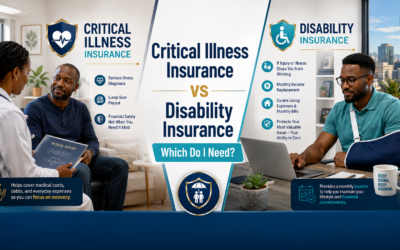
Your greatest financial asset is not your house, your car, or even your investment portfolio it is your ability to earn an income. For most South Africans, monthly income is what keeps the household running: bond or rent payments, school fees, groceries, transport, medical aid, insurance premiums, savings, and support for loved ones. Disability insurance exists to protect that income-earning ability when illness or injury affects your capacity to work. In financial planning, disability cover is not only about “being disabled”; it is about protecting your lifestyle, your family, your future goals, and your dignity when your ability to generate income is interrupted or permanently lost.
Ability to Earn Income
When we speak about disability insurance, we are really speaking about the economic value of your future earnings. A 35-year-old earning R30,000 per month still has many years of potential income ahead. Over 20 or 30 years, that income can represent millions of rand before retirement. That is why financial planners often describe your earning ability as your most important asset.
In South Africa, many families depend on one or two income earners. If one person’s income stops, the impact can be immediate and severe. Debit orders continue, household expenses continue, and dependants still need support. Disability insurance helps to reduce this financial shock by providing either a monthly income benefit, a lump-sum benefit, or a combination of both.
Income protection is generally designed to pay a monthly benefit when you are unable to work due to illness or injury, while lump-sum disability cover generally pays a once-off amount when a permanent disability meets the policy definition. A combination of the two can be useful because monthly benefits help replace income, while lump-sum benefits can address once-off capital needs.
Life Insurance: How to Protect Your Family Financially After Death?
Loss of the Ability to Earn Income
The loss of income-earning ability can happen suddenly through an accident, or gradually through illness. It may be temporary, such as recovering from surgery, or permanent, such as a severe physical impairment, neurological condition, or chronic illness that prevents you from performing your work.
This is where policy definitions become very important. Some policies assess whether you can perform your own occupation, while others consider whether you can perform any occupation suited to your education, training, and experience. The difference can have a major impact at claim stage because being unable to do your current job is not always the same as being unable to do any type of work. For example, a surgeon, mechanic, hairdresser, driver, financial adviser, or teacher may all rely on specific physical, cognitive, communication, or technical skills. If a medical condition prevents them from performing the core duties of their occupation, their income may be at risk even if they could theoretically perform another role. This is why South Africans should never buy disability cover based on price alone. The wording, waiting period, benefit period, exclusions, occupation class, and claims definitions matter.
It is also important to understand that being medically boarded by an employer does not automatically guarantee a disability insurance payout. Insurers assess claims against the wording and definitions contained in the policy contract.
Capital Needs After Disability
A disability can create immediate and long-term capital needs. These may include settling debt, adapting a home, modifying a vehicle, paying for medical equipment, covering rehabilitation costs, funding specialist care, or creating an emergency reserve while the family adjusts.
This is where lump-sum disability cover can play a powerful role. A once-off payout may help reduce financial pressure by settling a bond, reducing debt, or creating a capital buffer. However, lump-sum cover should not always be seen as a replacement for income protection. A lump sum can be spent too quickly if it is expected to cover both once-off expenses and monthly living costs for many years.
A practical financial plan often separates disability needs into two categories: income needs and capital needs. Income needs relate to replacing monthly earnings, while capital needs relate to once-off financial obligations caused by disability. When these needs are calculated separately, the cover is usually more accurate and better aligned to real life.
Insurer Commitment
When you take out disability insurance, the insurer makes a contractual commitment to pay a valid claim if the policy conditions are met. This commitment depends on accurate underwriting, honest disclosure, premium payment, and compliance with the policy terms.
At application stage, the insurer may assess your health, occupation, income, lifestyle, medical history, and financial need. This is not just administration; it helps the insurer decide whether to offer cover, what premium to charge, whether exclusions apply, and how much cover is appropriate.
From the client’s side, full disclosure is essential. Not disclosing a medical condition, risky hobby, income details, or occupational risk can create problems at claim stage. From the insurer’s side, the commitment is to apply the policy wording fairly and assess claims according to the agreed terms. South Africa’s insurance environment is regulated, and the Policyholder Protection Rules are intended to strengthen fair treatment, disclosure, and claims-handling standards for policyholders.
The strength of disability insurance lies in this exchange: the client pays premiums consistently, and the insurer promises financial support if a qualifying disability event occurs.
Premium Payable
The premium payable for disability insurance is influenced by several factors, including age, income, occupation, education, health status, smoking status, benefit amount, waiting period, benefit term, and the type of cover selected. Generally, more comprehensive cover costs more because the insurer carries a higher risk.
A cheaper premium may look attractive, but it may come with stricter definitions, longer waiting periods, shorter benefit periods, exclusions, or lower claim certainty. On the other hand, the most expensive option is not automatically the best. The right cover should be affordable, sustainable, and suitable for your financial responsibilities.
Affordability matters because disability insurance only works if premiums are maintained. A policy that lapses due to non-payment leaves the client exposed. That is why a good financial planner will balance the ideal level of protection with what the client can realistically afford over the long term.
Why Disability Insurance Matters in South Africa
In the South African context, disability insurance is especially important because many households have limited emergency savings and high dependency ratios. One income often supports children, spouses, parents, extended family members, and debt obligations. When income stops, the effect is rarely individual — it affects the whole household.
Disability cover should therefore be seen as part of a broader financial plan, alongside life cover, critical illness cover, medical aid, emergency savings, retirement planning, and estate planning. It is not a product for “other people”; it is a financial safety net for anyone whose lifestyle depends on their ability to work.
Final Thoughts
Disability insurance protects more than income it protects choice, stability, and dignity. It gives you and your family breathing room when life changes unexpectedly. Whether you are formally employed, self-employed, a professional, entrepreneur, or breadwinner, the question is not only “What happens if I die?” but also “What happens if I survive, but can no longer earn the same income?”
The best time to review disability insurance is while you are healthy, earning, and still insurable. Speak to a qualified financial planner who can help you calculate your income needs, capital needs, affordability, and the most suitable structure for your circumstances.
Disability may be unpredictable, but your financial protection does not have to be.