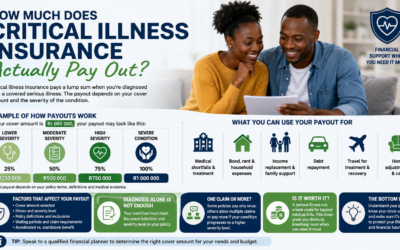
Critical illness insurance can feel like one of those “extra” covers people only think about after life cover, medical aid, gap cover and disability insurance. In South Africa, where household budgets are already under pressure, it is fair to ask: is critical illness insurance really worth the cost? The answer depends on your income, debt, dependants, medical aid, emergency savings and how much financial pressure a serious illness would create in your life.
Critical illness insurance, also known as dread disease cover or severe illness cover, usually pays a lump sum if you are diagnosed with a covered serious condition such as cancer, heart attack, stroke or another illness listed in your policy. The key point is that this money is normally paid to you, not to the hospital, which means you can use it for recovery costs, medical shortfalls, home changes, debt, family expenses, income gaps or anything else your situation requires. ASISA explains that critical illness cover is designed to help ensure that surviving a major illness does not result in financial hardship.
Why Medical Aid Alone May Not Be Enough
Many people assume that if they have medical aid, they do not need critical illness cover. That is a risky assumption. Medical aid is designed to pay for qualifying medical treatment according to the rules of your scheme and option. It does not necessarily replace your income, pay your bond, cover school fees, settle debt, fund a caregiver, pay for transport to specialists or give you time to recover without rushing back to work.
A serious illness can create costs beyond the hospital bill. You may need unpaid leave, a reduced work schedule, extra childcare, home support, rehabilitation, transport, lifestyle adjustments or specialised care. Critical illness cover helps with the financial impact around the illness, not only the illness itself. Rateweb describes this as the gap medical aid does not cover: income lost during recovery, lifestyle adaptations and the surrounding costs of a major diagnosis.
The Real Question: Can You Afford Not to Have It?
The value of critical illness insurance becomes clearer when you ask a different question: what would happen financially if I were diagnosed with a serious illness tomorrow? Could you still pay your bond or rent? Could your family manage for six months if your income dropped? Could you afford treatment-related shortfalls? Would you need to use savings meant for retirement, education or business growth?
South Africa’s financial protection gap remains a major concern. The 2025 ASISA Insurance Gap Study found that South Africa’s 16.1 million formally employed income earners generated around R4 trillion in annual gross earnings, but had only R1.1 trillion worth of critical illness cover at the end of December 2024. This suggests that many working South Africans may not have enough protection if a serious illness disrupts their ability to earn, recover and maintain their lifestyle.
When Critical Illness Insurance Is Worth It
Critical illness cover is usually worth considering if you have financial responsibilities that would continue even if your health changed. This includes a bond, vehicle finance, personal loans, school fees, dependants, elderly parents, business obligations or limited emergency savings. It is also valuable if your income depends on your ability to show up consistently, such as for business owners, commission earners, professionals and self-employed people.
It may also be worth it if you have a family history of serious illness, high medical scheme exposure, or a lifestyle where a major health event would require expensive adjustments. The lump-sum benefit can give you options: reduce debt, fund recovery, replace lost income temporarily, pay for care or simply protect your family from immediate financial stress.
When It May Be Less Urgent
Critical illness insurance may be less urgent if you already have strong emergency savings, comprehensive medical aid, sufficient income protection, low debt and no dependants. Even then, it should not be dismissed completely. Serious illness does not only affect people with dependants; it can affect your independence, savings, career and long-term financial goals.
The decision is not about fear. It is about whether your current financial plan can absorb the shock of a major diagnosis without collapsing. If the answer is no, critical illness cover deserves attention.
The Cost Must Match the Benefit
Premiums for critical illness insurance depend on your age, health, smoking status, occupation, family history, cover amount and the type of benefit selected. A broader policy with more covered conditions, stronger definitions, severity-based benefits or multiple-claim features may cost more than a basic policy. The cheapest cover is not always the best cover, especially if the definitions are narrow or the payout conditions are difficult to meet.
This is why policy wording matters. Some policies pay only if the illness reaches a specific severity level. Others may pay a percentage of the benefit depending on the seriousness of the condition. Some benefits are standalone, while others are accelerated, meaning a claim may reduce your life cover. Before judging the cost, you must understand exactly what the insurer is committing to pay for, under what circumstances, and how the claim will affect your other benefits.
Critical Illness Cover vs Disability Cover
Critical illness insurance should not be confused with disability insurance. Critical illness cover pays because you suffer a qualifying serious illness. Disability cover pays because illness or injury affects your ability to work. You could have a serious illness and still be able to work, or you could be unable to work because of a condition that does not qualify under a critical illness policy.
For many people, the best structure is not choosing one over the other, but building a balanced protection plan. Disability or income protection helps protect monthly income. Critical illness cover helps with capital needs after a serious diagnosis. Medical aid helps with treatment costs. Gap cover helps with certain medical expense shortfalls. Each product solves a different problem.
How Much Cover Is Enough?
There is no single correct amount for everyone. A practical starting point is to consider the financial pressure that could arise during recovery. This may include six to twelve months of income, medical shortfalls, debt reduction, home adjustments, caregiver costs, transport, school fees and emergency savings. A financial planner can help calculate a realistic amount instead of guessing.
The right amount should be meaningful enough to make a difference, but affordable enough to keep in force. Insurance only works if you can maintain the premium over time.
Final Verdict: Is It Worth the Cost?
Yes, critical illness insurance can be worth the cost — especially if a serious illness would place your income, family and financial goals under pressure. It is not a luxury when you consider the real financial consequences of surviving a major health event. It is a financial safety net that gives you choices when your health, work and household responsibilities are all under strain.
However, it must be structured correctly. Do not buy it blindly. Understand the covered conditions, claim definitions, exclusions, waiting periods, premium pattern and whether the benefit is standalone or linked to your life cover. The true value of critical illness insurance is not just the payout; it is the breathing room it gives you when life demands recovery, not financial panic.
Before deciding, speak to a qualified financial planner who can review your medical aid, gap cover, disability cover, life cover, debt, savings and family responsibilities. The goal is not to pay for every product available. The goal is to build a protection plan that fits your life and protects your future.